 The chicken
 is a descendant of the Southeast Asian red jungle fowl first domesticated in India around 2000 B.C.
Description: warm, sweet; affects the spleen and stomach
As with any perishable meat and fish, bacteria can be present on raw or undercooked chicken. They multiply rapidly at temperatures between 40 °F and 140 °F (out of refrigeration and before thorough cooking occurs). Freezing does not kill bacteria but thorough cooking destroys them.
Following are some bacteria associated with chicken:
• Salmonella enteritidis are present in the intestinal tracts of livestock, poultry, dogs, cats and other warm-blooded animals. This strain is only one of about 2,000 kinds of salmonella bacteria.
• Staphylococcus aureus are normally present on human hands, in nasal passages and throats. The bacteria can be present in foods such as chicken salad, made by hand and improperly refrigerated.
• Campylobacter jejuni is one of the most common causes of diarrhea in humans.
• Listeria monocytogenes are destroyed by thorough cooking, but a cooked product can still be contaminated by poor personal hygiene and food handling.
It may be necessary to give antibiotics to prevent disease and increase feed efficiency but a "withdrawal" period is required from the time the antibiotics are administered before the bird can be slaughtered. This ensures that no residues are present in the bird's system.
In order to cause illnesses, the bacterium has to be consumed; they cannot enter the body through a skin cut. However, cross-contamination can occur if raw poultry or its juices contact cooked food or uncooked foods such as salad. An example of this is cutting tomatoes on an unwashed cutting board just after cutting raw chicken on it. Most food borne illness outbreaks are a result of contamination from food handlers. Sanitary food handling and proper cooking and refrigeration should prevent food borne illnesses.
It is always best to buy a product before the date expires. The use-by date is for quality assurance; after the date, peak quality begins to lessen but the product may still be used. If the use-by date expires while the chicken is frozen, the food can still be used.
Most people think the pink liquid in packaged fresh chicken is blood, but it is mostly water absorbed by the chicken during the chilling process. Blood is removed from poultry during slaughter and only a small amount remains in the muscle tissue. An improperly bled chicken would have cherry red skin and should not be eaten. Put packages of chicken in disposable plastic bags (if available) to contain any leakage that could cross-contaminate cooked foods or produce.
At home, immediately place chicken in a refrigerator that maintains 40 °F, and use within 1 or 2 days, or freeze at 0 °F. If kept frozen continuously, it will be safe indefinitely. Chicken may be frozen in its original packaging or repackaged. If freezing longer than two months, over wrap the porous store plastic packages with airtight heavy-duty foil, plastic wrap or freezer paper, or place the package inside a freezer bag. Proper wrapping prevents "freezer burn", which appears as grayish-brown leathery spots. Cut freezer-burned portions away either before or after cooking the chicken.
There are three safe and proper ways to defrost chicken:
• in the refrigerator. Once the raw chicken defrosts, it is safe to keep in the refrigerator an additional day or two before cooking.
• in cold water in its airtight packaging or in a leak proof bag.
• in the microwave. Chicken defrosted in the microwave should be cooked immediately after thawing because some areas of the food may become warm and begin to cook during microwaving.
Never defrost chicken on the counter or in other locations. Always plan ahead for slow, safe thawing in the refrigerator. During this time, if the chicken is not used, it is safe to refreeze without cooking first. Foods defrosted in the microwave or using the cold water method should be cooked before refreezing.
Cooking Tips
Cook whole chicken to a safe minimum internal temperature of 165 °F using a food thermometer.
Never pre-stuff whole chicken to cook at a later time; always stuff immediately before cooking.
Various cuts of chicken

chicken whole leg

chicken breast

chicken keel

chicken wings
Eggs
Description: neutral, sweet; affects the heart and stomach
Eggs are among the most nutritious foods on earth and can be part of a healthy diet. However, they are perishable just like raw meat, poultry, and fish. Unbroken, clean, fresh shell eggs may contain Salmonella Enteritidis (SE) bacteria that can cause food borne illness. While the number of eggs affected is quite small, there have been cases of food borne illness in the last few years. Young children, older adults, pregnant women (the risk is to the unborn child), and people with a weakened immune system are particularly vulnerable to SE infections.
How Does Salmonella Infect Eggs?
Bacteria can be on the outside of a shell egg. This is because the egg exits the hen's body through the same passageway as feces. Bacteria can be inside an uncracked, whole egg where contamination may be due to bacteria within the hen's ovary or oviduct before the shell forms around the yolk and white. It is also possible for Salmonella Enteritidis to enter the eggs through the pores of the shells after they are laid. This is why the processing plant washes and sanitizes the eggs before packing them.
Safe handling and cooking tips
• Keep eggs refrigerated, cook eggs until yolks are firm, and cook foods containing eggs thoroughly.
• Do not eat raw or undercooked egg yolks and whites or products containing raw or undercooked eggs.
• Always break the eggs just before cooking to preserve the resilience of the egg white.
• A rotten egg will ruin the other eggs in the dish. Thus break the eggs separately into bowls to ensure freshness for all.
• An egg that is old will float in water when its air cell has enlarged sufficiently to keep it buoyant, but it is perfectly safe to use.
• The fresher the egg, the more difficult it is to peel after hard cooking.
Variation in egg color is due to many factors.
• Blood spots are due to rupture of one or more small blood vessels in the yolk at the time of ovulation. It does not indicate the egg is unsafe.
• A cloudy white (albumen) is a sign the egg is very fresh. A clear egg white is an indication the egg is aging.
• Pink or iridescent egg white (albumen) indicates spoilage due to Pseudomonas bacteria. Some microorganisms produce a greenish, fluorescent, water-soluble pigment, and are harmful to humans.
• The color of yolk varies in shades of yellow depending upon the diet of the hen. If she eats plenty of yellow-orange plant pigments, such as from marigold petals and yellow corn, the yolk will be a darker yellow than if she eats a colorless diet such as white cornmeal.
• A green ring on a hard-cooked yolk is a result of overcooking, and is due to sulfur and iron compounds in the egg reacting on the yolk's surface. The green color can also be caused by a high amount of iron in the cooking water. The green color is safe to consume.
Century or thousand year eggs
These Chinese eggs are not really 1,000 years old, but are somewhere between a month and several years old. The eggs are converted into an entirely different food, probably by bacterial action. The following are several types of thousand-year-old Chinese eggs.

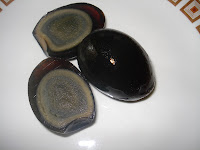
"Pidan," a great delicacy, is made by covering the eggs with lime, salt, wood ashes, and a tea infusion for 5 months or more. The egg yolks become greenish gray and the albumen turns into a coffee-brown jelly. Pidan smell ammonia-like and taste like lime.

"Humdan" results when eggs are individually coated with a mixture of salt and wet clay or ashes for a month. This process darkens and partially solidifies the yolks, and gives the eggs a salty taste.


